
Written by Dr Georgios Siskos, Ophthalmic Surgeon (FEBO). Last updated: November 2026.
In brief
Refractive surgery is the permanent correction of refractive errors, such as myopia, astigmatism, hyperopia and presbyopia. The aim is not simply freedom from glasses or contact lenses, but better everyday functioning, safely and with realistic expectations.
Refractive surgery may be suitable when:
Suitability is not based only on the prescription, but on the overall health of the eyes.
There are different refractive surgery techniques, such as laser techniques or intraocular solutions. The choice is individualised, after a detailed pre-operative assessment. There is no single solution that suits everyone, and proper information is decisive for the final result.
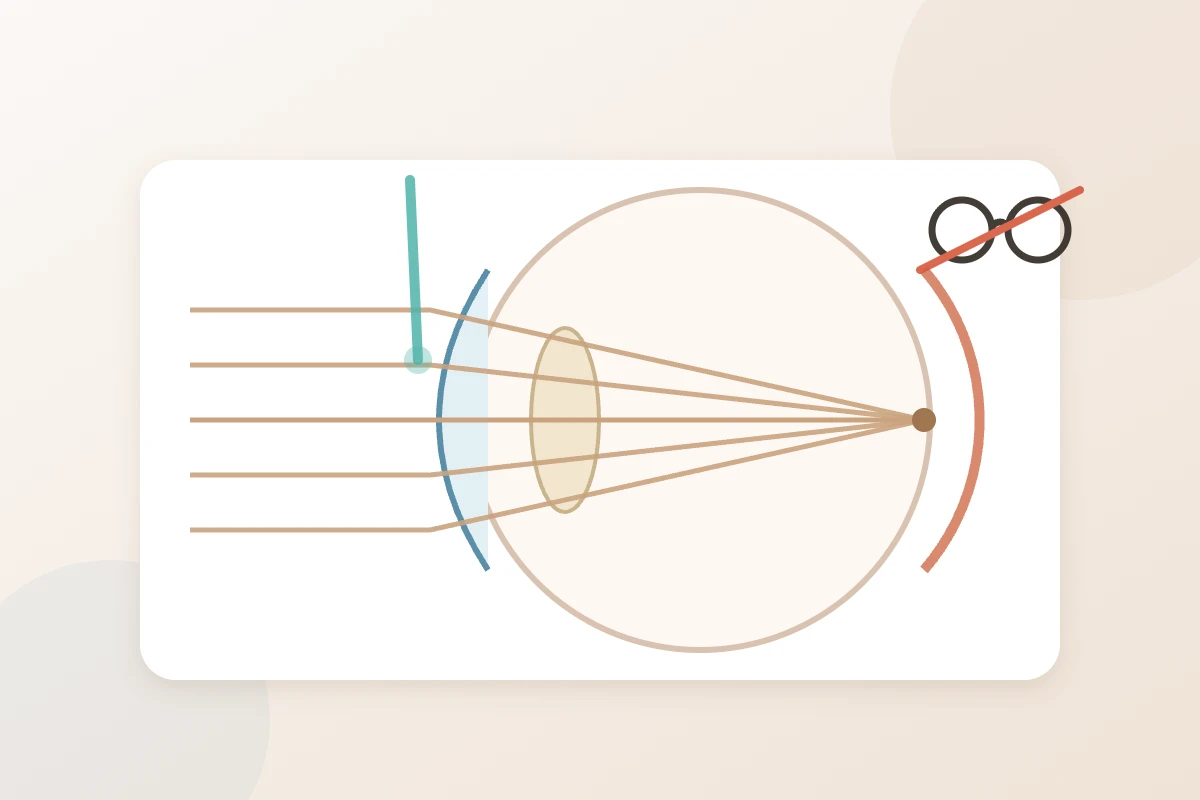
The laser changes the curvature of the cornea so that light focuses correctly inside the eye. These techniques are suitable for myopia, hyperopia and astigmatism, when the cornea is thick enough and normally shaped. The procedure is done with local anaesthetic drops and takes a few minutes per eye.
A thin lens is placed inside the eye, in front of the natural lens, without removing anything. It is a good option for high myopia or when the cornea is thin or unsuitable for laser.
Presbyopia is a natural change in vision after the age of 40–45. It can now be treated to an excellent degree by removing the natural lens and implanting an intraocular lens. Two important advantages of this technique are the stability of the result and the prevention of cataract, since the natural lens is replaced. Read more about how the right intraocular lens is chosen.
Refractive surgery is not a decision to rush. With the right choice and responsible guidance, however, it can offer reliable and stable results.
▶ Watch the videos: short videos by Dr Siskos on myopia, laser and ICL
▶ Watch the videos: short videos by Dr Siskos on presbyopia
Karditsa: our practice, Karaiskaki 23. Appointments on +30 2441 072740 or online via InstaDoctor.
It depends on your prescription and how stable it is, on the thickness and shape of your cornea and on the general health of your eyes. This can only be judged with a detailed pre-operative assessment.
Usually after 18, when the prescription has been stable for at least a year.
Laser corrects myopia, hyperopia and astigmatism, but does not stop presbyopia. After 40–45 most people will need reading glasses, unless a solution for presbyopia is chosen.
With an ICL the natural lens stays and the new lens is added in front of it; it usually suits younger patients. With lens replacement the natural lens is removed and replaced with an intraocular lens; it is usually preferable after 45–50, when presbyopia is present.