
Written by Dr Georgios Siskos, Ophthalmic Surgeon (FEBO), specialised in oculoplastic surgery (eyelids and lacrimal system). Last updated: November 2026.
In brief
Conditions of the lacrimal system, such as watery eye, a blocked tear duct, dacryocystitis and inflammation of the tear drainage pathways, can significantly affect the comfort and health of the eyes. At our practice in Karditsa we carry out a complete assessment, aiming at an accurate diagnosis and treatment.
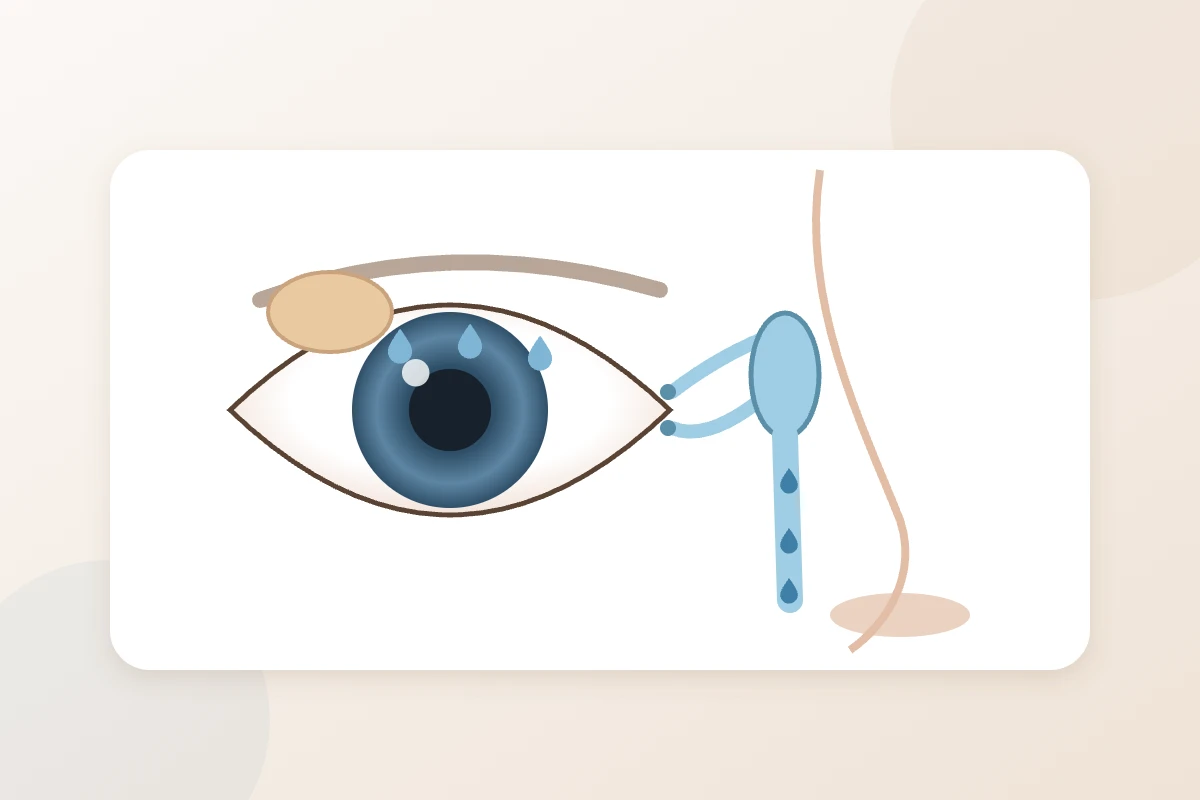
Tears are produced by the lacrimal gland, under the upper eyelid, and spread over the eye with every blink. They then pass through two small openings at the inner corner of the eyelids (the puncta), reach the lacrimal sac and from there, through the nasolacrimal duct, the nose. If any point along this route is blocked, or if the eyelid does not “pump” the tears properly, they overflow onto the cheek.
The eye waters all the time, even without emotion or irritation. The cause is not always a blockage: dry eye, blepharitis and lax eyelids can also cause tearing. That is why a correct diagnosis comes before any treatment. Read more in our article on the constantly watering eye.
This is the most common cause of watery eye in adults, especially in older age. Apart from tearing, there may be sticky discharge and blurred vision caused by the excess tears.
When tears stagnate in the lacrimal sac, they can become infected. A red, painful swelling then appears at the inner corner of the eye, next to the nose. Acute infection needs prompt medical assessment and antibiotics, while repeated infections show that a definitive solution is needed.
In quite a few newborns the duct has not fully opened at birth, and the eye waters or has discharge. In most cases the problem resolves on its own within the first year of life. If it persists, an eye assessment is needed.
The examination includes checking the surface of the eye and the eyelids and, when needed, irrigation of the tear ducts: a saline solution is passed through the punctum to see whether it reaches the nose freely. It is done with local anaesthetic drops and is quick.
We offer minimally invasive treatments, as well as complete restoration with dacryocystorhinostomy, the most effective method of restoring the normal flow of tears. The approach is individualised, aiming at a permanent solution to the watery eye and at avoiding recurrences or infections.
In dacryocystorhinostomy (DCR) a new passage is created between the lacrimal sac and the nose, so that tears bypass the point of the blockage. In our practice it is performed via an external approach, through a small incision on the side of the nose, under local anaesthesia without sedation, and the patient goes home the same day. Silicone tubes are not placed routinely.
▶ Watch the videos: short videos by Dr Siskos on eyelids and watery eye
We see patients from Karditsa, Larisa, Trikala and the whole of Thessaly who are looking for care from a surgeon specialised in the lacrimal system.
Karditsa: our practice, Karaiskaki 23. Appointments on +30 2441 072740 or online via InstaDoctor.
Larisa: every Wednesday, Patsidis Clinic (Theofrastou 75), for eyelid and lacrimal system conditions. Appointments on +30 697 033 8672.
Dry eye irritates the surface of the eye and the body responds with “reflex” tears. In this case, treating the dry eye also reduces the tearing. The difference from a blockage is established by the examination.
The operation is performed under local anaesthesia, so the patient feels no pain during it. Afterwards there may be mild discomfort and swelling for a few days, which are managed with simple painkillers.
The incision is small and follows the natural lines of the skin next to the nose. In most patients, once healed, it is barely visible.
External dacryocystorhinostomy has very high success rates. In a small proportion of patients the new passage may narrow again, in which case a reassessment is needed.
At our practice in Karditsa (Karaiskaki 23) and every Wednesday in Larisa, at the Patsidis Clinic, where Dr Siskos sees patients with eyelid and lacrimal system conditions.