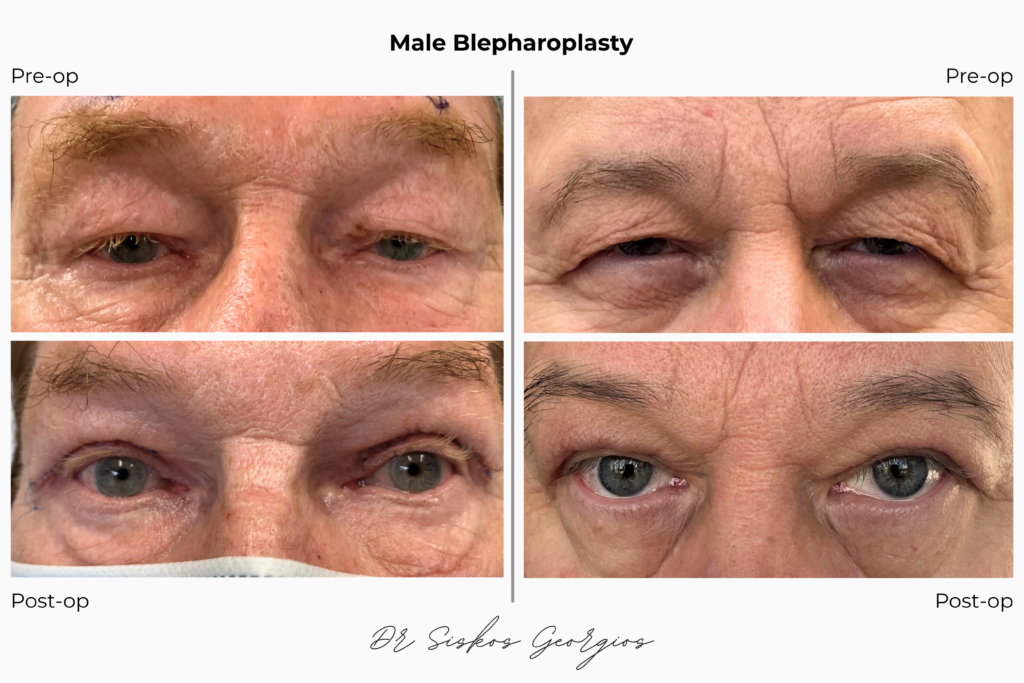
Written by Dr Georgios Siskos, Ophthalmic Surgeon (FEBO), specialising in oculoplastic surgery and eyelid surgery. Last updated: November 2026.
In brief
- Upper eyelid blepharoplasty removes excess skin (and fat, when needed) from the upper eyelids.
- It is not only cosmetic: when the skin hangs over the eyelashes, it can limit vision upwards and to the sides.
- Dermatochalasis must be distinguished from eyelid ptosis: they often coexist and need different correction.
- It is performed under local anaesthesia only, without sedatives, it lasts 30–60 minutes and you return home the same day.
- Return to work in 7–10 days and final result in 2–3 months.
What is upper eyelid blepharoplasty?
Upper eyelid blepharoplasty is a surgical procedure in which excess skin and fat are removed from the upper eyelids, when this is needed. The aim is to restore a more rested look, to improve vision when the skin limits the temporal visual field and to achieve a natural cosmetic result.
Upper blepharoplasty is one of the most common cosmetic and also functional procedures in ophthalmology.
When is upper blepharoplasty needed?
Blepharoplasty can be useful when:
- The skin of the upper eyelids hangs over the eyelashes, pushing them downwards.
- There is a feeling of heaviness in the eyes.
- Vision upwards or to the sides has become limited.
- The eyes constantly look tired.
- There is difficulty applying make-up because of the excess skin.
- There is asymmetry between the two eyelids.
In most patients the procedure is done for both functional and cosmetic reasons.
Is it only a cosmetic procedure?
No.
Many patients believe that blepharoplasty concerns appearance exclusively. In reality, when there is significant excess skin, the upper and temporal visual field can be significantly affected.
In these cases the procedure improves not only the appearance but also the patient’s daily life.
What is the difference between dermatochalasis and eyelid ptosis?
This distinction is particularly important.
Dermatochalasis
The excess mainly concerns the skin, which forms folds and covers the eyelid.
Eyelid ptosis
The eyelid itself sits lower because the muscle that normally raises it does not work properly.
In many patients both conditions coexist. If only the excess skin is corrected while ptosis is also present, the result may not be satisfactory.
For this reason, the ideal upper blepharoplasty surgeon is one who can combine correction of the excess skin with repositioning of the levator muscle of the eyelid at the same time.
Dermatochalasis or eyelid ptosis?
Tap to see the difference, and how the eyelid changes after blepharoplasty.
Schematic illustration for understanding. The exact diagnosis is made by clinical examination.
How is the procedure performed?
The procedure is always performed under local anaesthesia only and without sedatives (sedation), for the safest performance of an otherwise comfortable and quick procedure.
The surgeon:
- carefully marks the area to be removed
- removes only the necessary amount of skin
- removes or reshapes fat when needed
- preserves the natural anatomy of the eyelid
- closes the incision with very fine stitches
The incision is placed within the natural crease of the eyelid, so that after healing it is barely visible.
How long does it take?
Usually 30–60 minutes, and the patient returns home the same day without gauze dressings.
Does it hurt?
Most patients report that the procedure is much easier than they expected.
During the procedure there is only the prick of the local anaesthetic.
After the procedure there is usually mild discomfort, like a feeling of heaviness, and not pain.
What is recovery like?
In the first days it is normal for the following to appear:
- swelling
- small bruises
- mild watering of the eyes
- a feeling of tightness
Our patients:
- return to light activities in 2–3 days
- have the stitches removed after about one week
- return to work within 7–10 days
- see the final result in 2–3 months, as healing is completed.
Recovery step by step
- 1Day of the procedure30–60 minutes, under local anaesthesia only. Return home the same day, without gauze dressings.
- 22–3 daysReturn to light activities. Swelling and small bruises are normal.
- 3About 1 weekRemoval of the stitches.
- 47–10 daysReturn to work.
- 52–3 monthsFinal result, as healing is completed.
The times are indicative and differ from person to person.
How long does the result last?
The results usually last for many years.
The natural ageing process continues, but most patients do not need another procedure for a very long time.
Are there risks?
Like every surgical procedure, blepharoplasty is accompanied by possible complications, although they are relatively rare when it is performed by an experienced surgeon.
Possible complications include:
- haematoma, which stops and is absorbed on its own in the overwhelming majority of cases
- infection, which is very rare in the eyelid area and is treated with antibiotics
- asymmetry, which exists naturally and is to some degree expected
- temporary dry eye for a few days, which is treated with artificial tears
- excessive or insufficient removal of skin, which is why removal is always conservative and precise
- difficulty closing the eyelids fully, perhaps for a few hours after the procedure
- a visible scar, which is particularly rare
Correct preoperative assessment and specialised care significantly reduce these risks, which, however, are usually easy to manage.
Who is a suitable candidate?
Suitable candidates are all those who have realistic expectations and do not wish their face to change dramatically.
Frequently asked questions
Will the shape of my eyes change?
No. A correctly planned blepharoplasty preserves the natural shape of the eyes.
Will I look “pulled”?
No, the aim is a natural result. Most people will notice that you look more rested, without necessarily realising that you have had surgery.
Can I have blepharoplasty if I take anticoagulants?
Yes, but coordination with your treating doctor and individualised planning are required.
Will I need general anaesthesia?
No. The procedure is performed under local anaesthesia only, without sedatives (sedation) or general anaesthesia.
From what age can it be done?
There is no specific age limit. The indication depends on the anatomical characteristics and the symptoms of the patient.
Why is an examination by an ophthalmologist specialising in eyelids important?
The eyelids protect the cornea and contribute to the normal function of the eye.
Before any procedure, the following must be assessed:
- the position of the eyelids
- the function of the eyelid muscles and the presence of eyelid ptosis
- the quality of the tear film and the presence of dry eye
- the symmetry of the face
The correct diagnosis is just as important as the procedure itself and helps to achieve a safe, functional and natural result.
See also: Eyelid conditions